Canadian Citizen
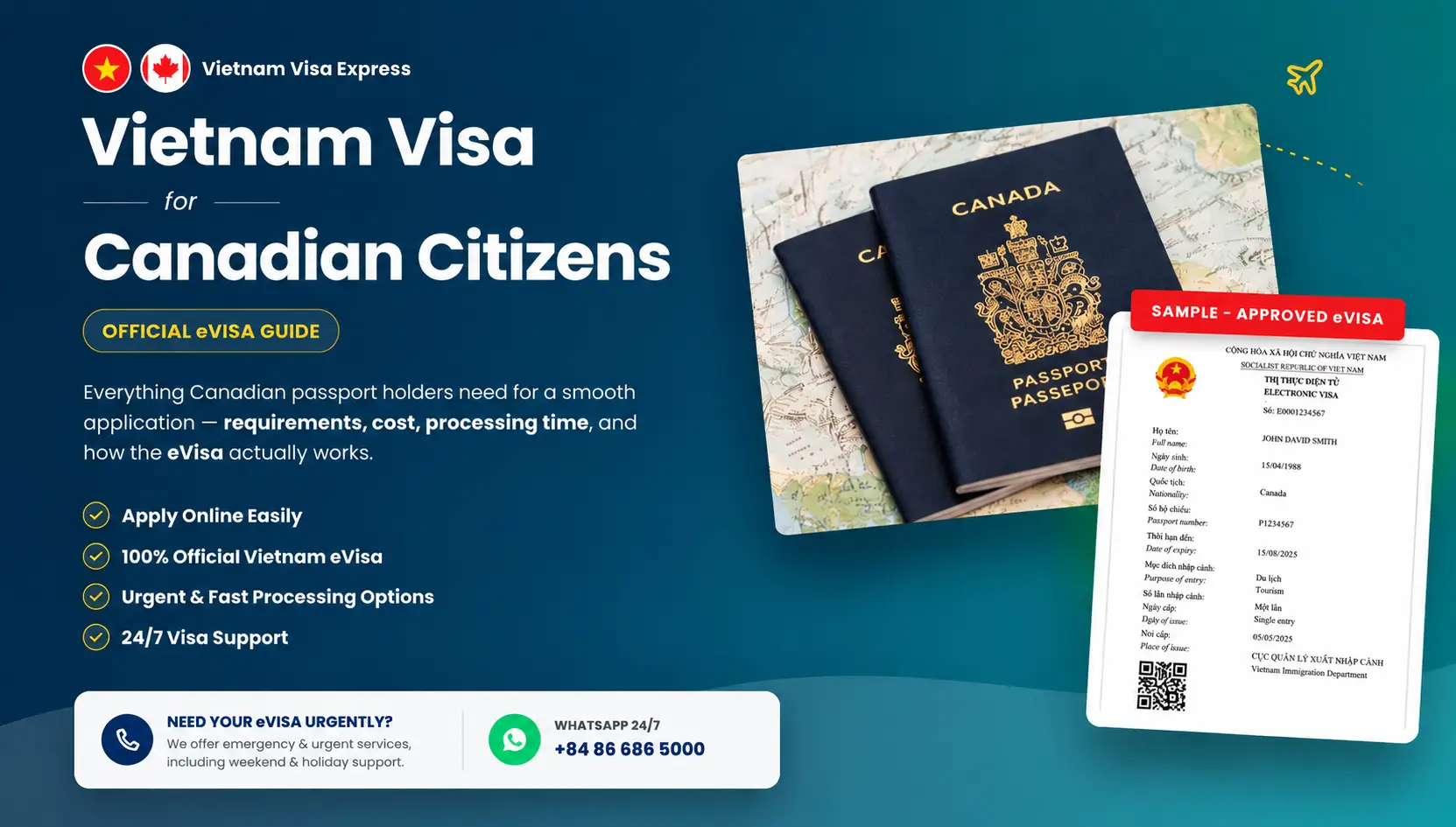
Planning a trip to Vietnam from Canada? Understanding the Vietnam Visa for Canadian Citizen requirements, available visa options, fees and processing times is important for a smooth travel experience.
Canadian passport holders can apply for a Vietnam eVisa online, with options available for tourism, business and other eligible travel purposes.
Vietnam Visa for Canadian Citizen: Quick Overview
Do Canadian Citizens Need a Visa to Vietnam?
Yes. As of 2026, Canadian citizens need a visa to enter Vietnam.
Whether you are traveling for tourism, business or other purposes, obtaining the appropriate visa is essential. The application process can be completed online or through a Vietnamese embassy or consulate in Canada.
Travelers can review the latest Vietnam visa requirements before preparing their application.
Can Canadian Citizens Apply for a Vietnam eVisa?
Yes. Canadian citizens can apply for a Vietnam eVisa.
The eVisa provides a convenient online application option without requiring travelers to visit an embassy for the standard application process.
👉 Apply for Vietnam eVisa online
Travelers can also review official eVisa information through the
Vietnam Immigration eVisa portal.
Types of Vietnam Visas Available for Canadian Citizens
Vietnam offers several visa options based on the application method, purpose of visit and duration of stay.
Visa Types Based on Application Method
Vietnam eVisa: A convenient option that allows online applications without visiting an embassy. The eVisa can be issued for stays of up to 90 days and may be single or multiple entry depending on the approved application.
👉 Apply for Vietnam eVisa online
Visa on Arrival (VOA): Visa on Arrival may be available for qualifying emergency travel situations. Travelers who require this option should arrange the necessary approval before traveling.
Embassy Visa: Applicants may also apply directly through a Vietnamese embassy or consulate.
👉 Check the
Vietnamese embassy information
for your country.
Visa Types Based on Purpose of Visit
- Tourist Visa (DL): For travelers visiting Vietnam for tourism purposes.
- Business Visa (DN1, DN2): For individuals visiting Vietnam for business-related activities.
- Relative Visit Visa (TT): For those visiting relatives in Vietnam.
Visa Types Based on Length of Stay
- 30-day single entry: Allows one entry into Vietnam for up to 30 days.
- 30-day multiple entry: Allows multiple entries within a 30-day period.
- 90-day single entry: Allows one entry into Vietnam for up to 90 days.
- 90-day multiple entry: Allows multiple entries within a 90-day period.
Vietnam visa options for Canadian travelers primarily include the electronic visa and, in limited qualifying situations, Visa on Arrival.
While Canadians can apply for an eVisa independently, travelers may choose Vietnam Visa Express for additional assistance such as:
- Expert assistance with visa-related queries
- Avoiding common application mistakes
- Fast processing options based on travel schedules
- Assistance for urgent cases
Travelers arriving by air can also consider airport fast-track assistance for a smoother arrival experience.
Vietnam eVisa Eligibility and Requirements for Canadian Citizens
To apply for a Vietnam Visa for Canadian Citizen, travelers must provide the required information and documents accurately.
Vietnam eVisa Cost for Canadian Citizens
If you choose to apply for the Vietnam eVisa yourself through the official government website, the government fees are:
For official information and government application details, visit
evisa.gov.vn.
Vietnam eVisa Processing Time for Canadian Citizens
Processing time can depend on the application details, immigration review and the selected service option.
Government processing can take longer when additional verification is required.
Vietnam Visa Express also offers standard and expedited processing options for travelers with different departure schedules.
Processing options include:
- Standard processing: 5–7 business days.
- Expedited processing: Options may range from 1–2 business days to urgent processing as fast as 1–4 hours, depending on availability and the travel situation.
Vietnam Visa Express Processing Time & Fee
| Processing Time | Visa Type | Fee (USD/Pax) |
|---|---|---|
| 4 Hours | 1 Month Single Entry | US$169 |
| 1 Month Multiple Entry | US$199 | |
| 3 Month Single Entry | US$209 | |
| 3 Months Multiple Entry | US$219 | |
| 1 Day | 1 Month Single Entry | US$139 |
| 1 Month Multiple Entry | US$169 | |
| 3 Month Single Entry | US$179 | |
| 3 Months Multiple Entry | US$189 | |
| 2 Days | 1 Month Single Entry | US$99 |
| 1 Month Multiple Entry | US$129 | |
| 3 Month Single Entry | US$139 | |
| 3 Months Multiple Entry | US$149 | |
| Normal | 1 Month Single Entry | US$54 |
| 1 Month Multiple Entry | US$84 | |
| 3 Month Single Entry | US$94 | |
| 3 Months Multiple Entry | US$104 |
👉 Apply for a new Vietnam eVisa
👉 Expedite a pending Vietnam eVisa
How to Apply for a Vietnam Visa From Canada
Vietnam eVisa
- Visit our secure Vietnam eVisa application form.
- Fill in your personal and passport information accurately.
- Upload the required passport and photograph images.
- Pay the applicable visa and service fees.
- Receive your approved eVisa electronically.
- Check all information carefully before traveling.
- Carry your eVisa when entering Vietnam.
Visa on Arrival
Visa on Arrival is currently intended for qualifying urgent or emergency circumstances.
- Submit the required application information.
- Receive the necessary approval documentation.
- Prepare your passport, photographs and required documents.
- Present the documents at the applicable Visa on Arrival counter in Vietnam.
For urgent travel situations, see our
Urgent & Emergency Vietnam Visa service.
What If Your Vietnam eVisa Is Still Pending?
If you have already submitted a Vietnam eVisa application and its status is still showing Processing, you may not need to start an entirely new application.
Travelers whose departure date is approaching can review our
Expedited Pending Vietnam eVisa service
to check available options.
Approved Entry Points for Vietnam eVisa Holders
Vietnam eVisa holders must enter through an approved airport, land border checkpoint or seaport that accepts the eVisa.
The original Canada guide includes the following common entry points:
| Airports | Land Border Gates | Seaports |
|---|---|---|
| Noi Bai Airport (Hanoi) | Tay Trang Border Gate (Dien Bien) | Hon Gai Seaport (Quang Ninh) |
| Tan Son Nhat Airport (Ho Chi Minh City) | Mong Cai Border Gate (Quang Ninh) | Cam Pha Seaport (Quang Ninh) |
| Cam Ranh Airport (Khanh Hoa) | Huu Nghi Border Gate (Lang Son) | Hai Phong Seaport (Hai Phong) |
| Da Nang Airport (Da Nang) | Lao Cai Border Gate (Lao Cai) | Vung Ang Seaport (Ha Tinh) |
| Cat Bi Airport (Hai Phong) | Na Meo Border Gate (Thanh Hoa) | Chan May Seaport (Thua Thien Hue) |
| Can Tho Airport (Can Tho) | Nam Can Border Gate (Nghe An) | Da Nang Seaport (Da Nang) |
| Phu Quoc Airport (Kien Giang) | Cau Treo Border Gate (Ha Tinh) | Nha Trang Seaport (Khanh Hoa) |
| Phu Bai Airport (Thua Thien Hue) | Cha Lo Border Gate (Quang Binh) | Quy Nhon Seaport (Binh Dinh) |
| Van Don Airport (Quang Ninh) | La Lay Border Gate (Quang Tri) | Dung Quat Seaport (Quang Ngai) |
| Lien Khuong Airport (Lam Dong) | Lao Bao Border Gate (Quang Tri) | Vung Tau Seaport (Ba Ria-Vung Tau) |
| — | Bo Y Border Gate (Kon Tum) | Ho Chi Minh City Seaport |
| — | Moc Bai Border Gate (Tay Ninh) | Duong Dong Seaport (Kien Giang) |
| — | Xa Mat Border Gate (Tay Ninh) | — |
| — | Tinh Bien Border Gate (An Giang) | — |
| — | Song Tien Land and Waterway Border Gate (An Giang) | — |
| — | Ha Tien Border Gate (Kien Giang) | — |
Travelers should confirm that their intended entry checkpoint is permitted for their approved eVisa before departure.
For current official information, check the
Vietnam Immigration eVisa portal.
Enhance Your Vietnam Itinerary
With your eVisa ready, Vietnam’s diverse landscapes and rich history await your exploration.
- Ha Long Bay – Known for emerald waters and towering limestone islands. Visitors can enjoy cruises, cave exploration and kayaking.
Learn more about Ha Long Bay. - Hanoi – Explore the Old Quarter, Ho Chi Minh Mausoleum, Temple of Literature and Hoan Kiem Lake.
- Hoi An – Famous for its preserved Ancient Town, lantern-lit streets, traditional shops and riverside atmosphere.
- Hue – Vietnam’s former imperial capital, home to the historic Imperial City, royal tombs and pagodas.
Discover Hue. - Ho Chi Minh City – A lively metropolis with museums, markets, historical attractions, nightlife and local cuisine.
- Sapa – Famous for mountain landscapes, terraced rice fields and ethnic minority communities.
- Mekong Delta – Explore waterways, floating markets, fruit orchards and traditional villages.
- Phu Quoc Island – Enjoy tropical beaches, clear waters, coral reefs, Phu Quoc National Park and night markets.
Vietnam’s Weather Overview
Vietnam’s diverse geography results in varying climates across the country. Weather conditions can generally be considered across Northern, Central and Southern Vietnam.
Northern Vietnam
- Winter (Dec–Feb): Around 10°C to 20°C, generally cool with occasional drizzle. Suggested destinations include Hanoi, Sapa and Ha Long Bay.
- Spring (Mar–Apr): Around 15°C to 25°C with pleasant conditions. Suggested destinations include Hanoi, Ninh Binh and Moc Chau.
- Summer (May–Aug): Often above 30°C, hot and humid with showers and thunderstorms. Suggested destinations include Ha Long Bay, Sapa and Ba Be National Park.
- Autumn (Sep–Nov): Around 20°C to 25°C with cooler conditions. Suggested destinations include Mu Cang Chai, Ha Giang and Hanoi.
Central Vietnam
- Winter (Dec–Feb): Around 18°C to 25°C. Suggested destinations include Hue, Hoi An and Da Nang.
- Spring (Mar–Apr): Around 20°C to 30°C with comfortable travel conditions.
- Summer (May–Aug): Temperatures can exceed 35°C with hot and humid conditions.
- Autumn (Sep–Nov): Rainfall and typhoon conditions can affect parts of Central Vietnam.
Read more about
Hoi An.
Southern Vietnam
- Dry Season (Dec–May): Around 25°C to 35°C with warm and generally dry weather. Suggested destinations include Ho Chi Minh City, Phu Quoc and the Mekong Delta.
- Rainy Season (Jun–Nov): Frequent afternoon rain and high humidity. Suggested destinations include Can Tho, Con Dao and Vung Tau.
Travel Tips for Canadian Visitors to Vietnam
- Plan Ahead: Research destinations and book accommodation early during peak travel periods.
- Visa and Documents: Make sure your approved eVisa and travel documents are prepared before departure.
- Currency: Vietnamese Dong is widely used, and ATMs are available in major cities and tourist areas.
- Language: Basic Vietnamese phrases such as “Xin chào” and “Cảm ơn” may be useful.
- Cultural Etiquette: Dress appropriately when visiting religious sites and respect local customs.
- Transportation: Use reliable transportation services and plan domestic travel in advance.
- Connectivity: A local SIM or travel eSIM can make navigation and communication easier.
- Cuisine: Try popular Vietnamese dishes such as pho, banh mi and fresh spring rolls.
Apply for a Vietnam Visa From Canada
A Vietnam Visa for Canadian Citizen can be prepared online before departure, making the eVisa one of the most convenient options for Canadian passport holders traveling to Vietnam.